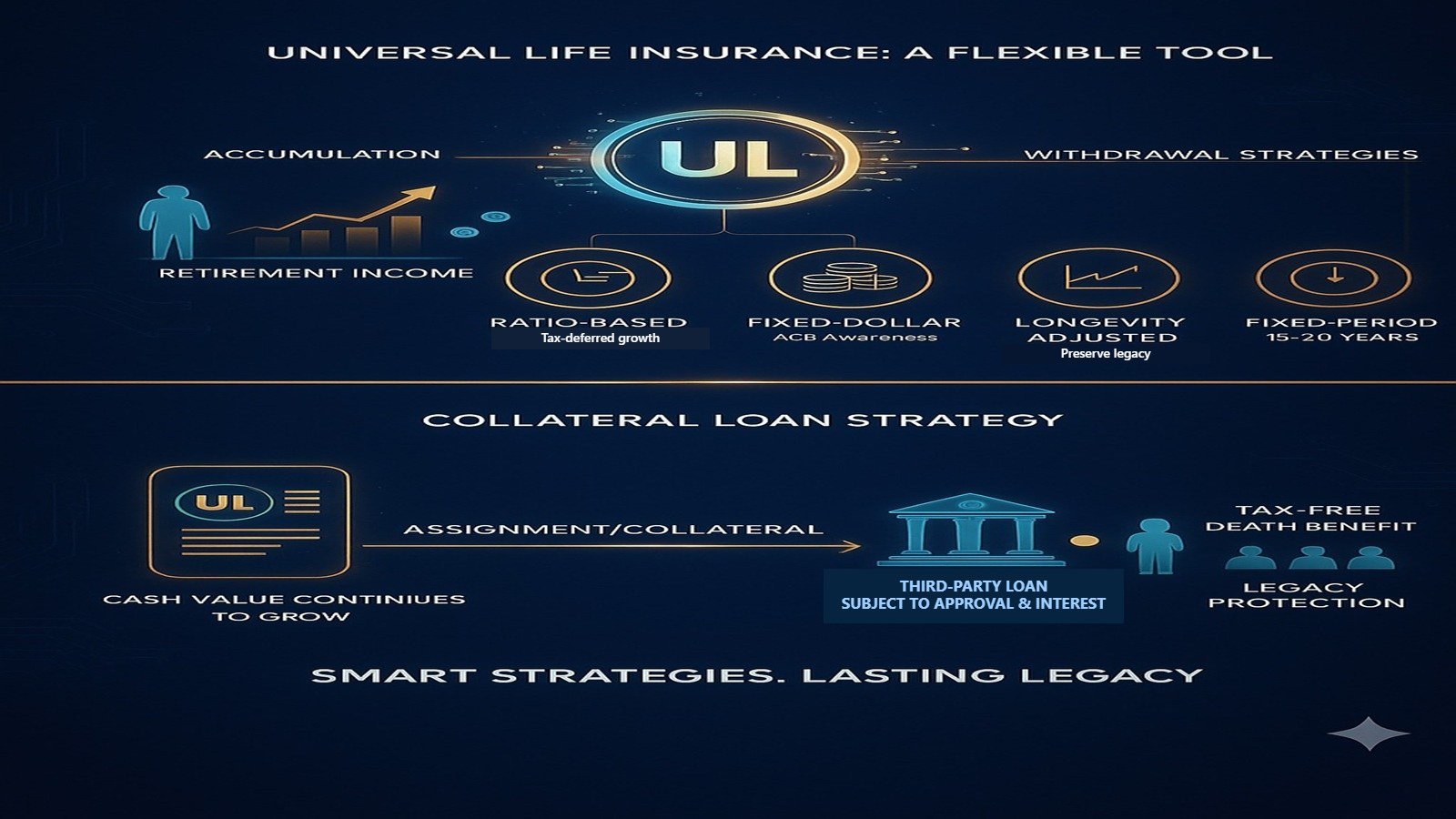
Understand the difference between a withdrawal, an insurer policy loan and a third-party collateral loan.
Insurance first, with an investment component
Universal life is permanent life insurance that combines coverage with an investment account. Premium flexibility operates within contractual limits, not as permission to stop funding the policy indefinitely. Account values and funding needs can change with investment performance and policy charges. [1]
Before considering retirement cash flow, establish the insurance need, required premiums, cost-of-insurance structure, surrender charges and guaranteed versus non-guaranteed assumptions. A projection is not a promise that the account will fund every future charge or distribution.
Three ways of accessing value are not interchangeable
A withdrawal or partial surrender removes value from the policy. It can reduce benefits and can create taxable policy income. Section 148 of the Income Tax Act governs dispositions, including partial dispositions, with rules allocating adjusted cost basis. Having an ACB does not mean every withdrawal below the total ACB is automatically tax-free. [2]
A policy loan is an advance from the insurer under the insurance contract. The Act includes policy loans within the definition of disposition, subject to detailed proceeds and ACB rules. A loan can therefore produce taxable income. It also creates a repayment obligation and can reduce net policy benefits. [2, 1]
A collateral loan is borrowing from a third-party lender secured by an assignment of the policy. The Act distinguishes such a security assignment from a policy loan and excludes the qualifying assignment itself from disposition. Loan proceeds are generally not income because they must be repaid, but that is not a guarantee that the overall strategy is tax-free. [2]
Debt changes the risk
A lender controls its own approval, interest rate, advance limits, security requirements and renewal terms. Future borrowing is not guaranteed. If returns disappoint, interest rates rise or lending terms change, additional cash or collateral may be required. A forced surrender can create tax and reduce the intended legacy.
Policy charges continue while a policy is assigned. Investment returns are not guaranteed merely because value remains in the policy. The loan and accumulated interest must eventually be settled, potentially from death proceeds, leaving less for beneficiaries. Borrowing does not create a second unrestricted pool of wealth. [1]
Withdrawal labels are not Canadian tax exemptions
Terms such as ratio-based, fixed-dollar, longevity-adjusted and fixed-period describe possible modelling approaches. They are not universal contract features or statutory safe harbours. None automatically guarantees tax-free cash flow, a lasting death benefit or policy sustainability.
Request stress tests using lower returns, higher loan rates, a longer life and interrupted funding. Compare the strategy with simpler alternatives and separately confirm any proposed interest deduction. Personal retirement spending does not make loan interest deductible simply because insurance secures the debt.
Review the plan continuously
Obtain in-force policy values, current tax information from the insurer and the actual lender agreement before taking money out. Review the policy and debt together. Universal life can offer flexibility, but its usefulness depends on suitability, realistic assumptions and the ability to manage both insurance funding and borrowing risk. [1, 2]
Important information and disclaimer
This is not a recommendation for leveraged insurance or an insured retirement strategy. Tax results depend on the policy, issue date, exempt status, transaction and use of borrowed funds. Obtain insurer calculations and independent tax advice. Loans, rates, deductions, returns and future access are not guaranteed. This article is for general information for a Canadian audience and is not individualized insurance, investment, tax, legal or accounting advice. It is not an offer or solicitation. Suitability depends on personal circumstances, affordability and objectives. Contracts, enacted legislation and applicable provincial rules prevail over summaries. Examples are illustrative; non-guaranteed values are not promises. Information was checked against the sources available on November 22, 2026 and may change. Consult appropriately licensed or qualified professionals before acting.
Sources
- Financial Consumer Agency of Canada: Life insurance
- Justice Canada: Income Tax Act, section 148
Sources reviewed November 22, 2026.