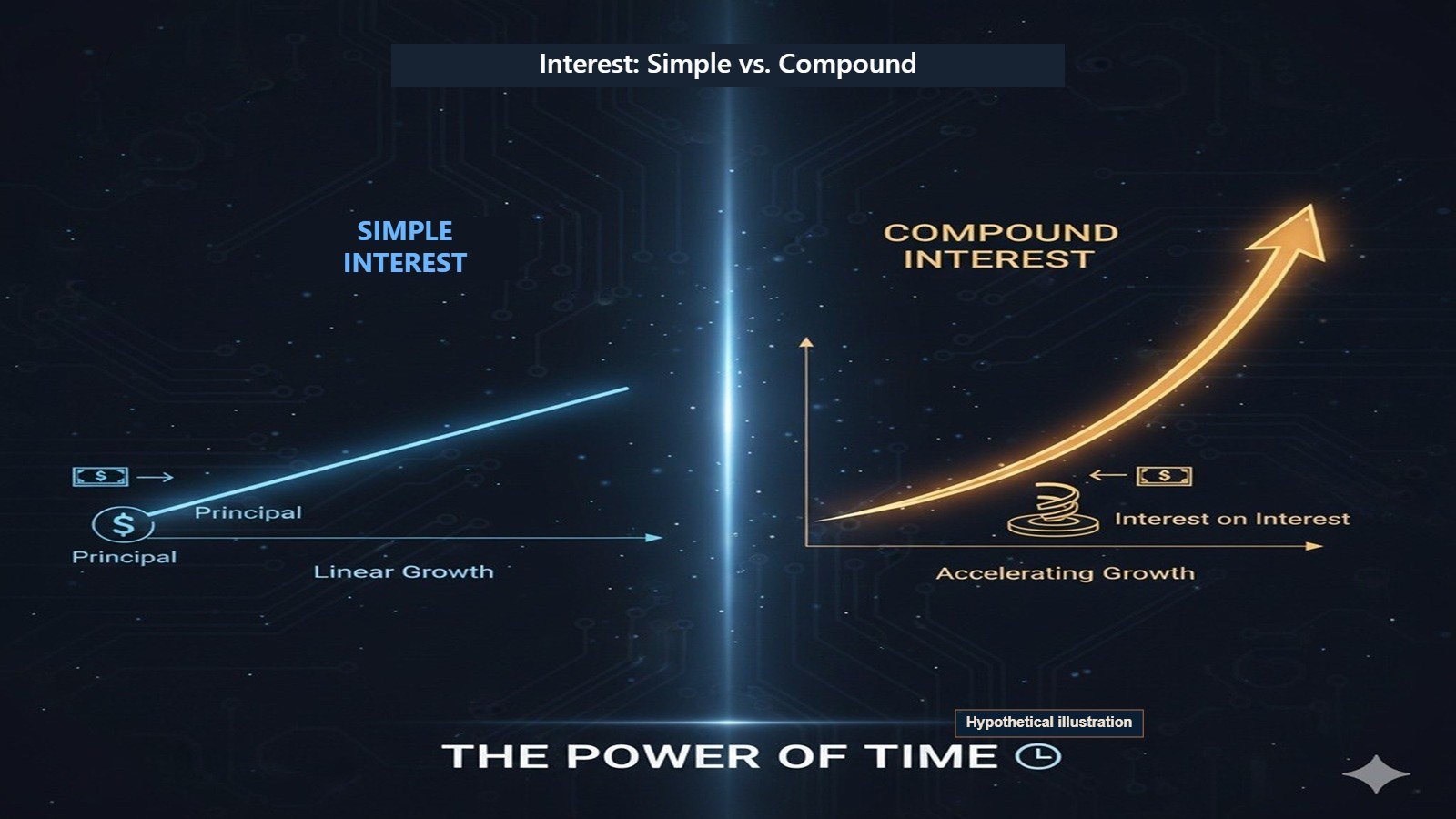
Interest on interest can change long-term results, but the assumptions matter.
Two different ways interest can work
Simple interest is calculated on the original principal rather than on previously accumulated interest. With compound interest, interest is added to the balance and can itself earn interest in later periods. FCAC describes this as earning interest on the new total balance. [2]
For a constant principal P, annual rate r and time t in years, simple-interest future value is P x (1 + r x t). With a constant nominal annual rate compounded n times a year, compound future value is P x (1 + r/n)^(n x t). These simplified formulas assume no additional deposits, withdrawals, taxes or fees.
A transparent illustration
Assume a single $10,000 deposit, a constant 5% annual rate and a 20-year holding period. With simple interest, the ending amount is $20,000: the $10,000 principal plus $10,000 of interest. With annual compounding, the ending amount is approximately $26,532.98.
The difference is approximately $6,532.98. These are mathematical examples, not available account rates or investment projections. There are no contributions or withdrawals, and the comparison ignores tax, fees and inflation. The assumed 5% is held constant solely to isolate the effect of compounding.
Accrued is not the opposite of compound
Accrued interest means interest that has been earned or accumulated but has not yet been paid or settled. It is not a synonym for simple interest. Interest can accrue under an arrangement that also compounds. For this reason, a chart contrasting accrued interest with compound interest should instead label its linear example simple interest.
Also distinguish when interest is calculated, credited and compounded. FCAC notes that savings accounts may compound monthly or daily and recommends asking the financial institution how its calculation works. The advertised annual rate does not tell the whole story. [2]
Compounding is not a promise of a smooth investment path
A constant-interest illustration is different from a market investment whose returns fluctuate. A rising curve should not suggest that investments always grow, that losses cannot occur or that an insurance cash-value projection behaves like a guaranteed savings account.
Universal-life cash values can increase or decrease with investment choices and returns, and funding needs may change. Do not apply a generic compound-interest curve to policy values without accounting for insurance charges, fees, taxes and the actual contract. [1]
Use time deliberately
Compare rates on a consistent basis and confirm compounding frequency, fees, access conditions and tax treatment. Regular saving can matter as much as seeking a higher stated rate. For borrowing, review the same mechanics: interest added to a balance can increase what you owe.
The lesson is not that a particular return is guaranteed. It is that time, rate, compounding and cash flows work together. A useful illustration makes each assumption visible so you can judge whether it applies to the real decision.
Important information and disclaimer
The 5% example is hypothetical, calculated with annual compounding and not a forecast, quote or guarantee. Actual returns, charges, taxes, inflation and cash flows change results. No deposit, investment or insurance product is recommended. This article is for general information for a Canadian audience and is not individualized insurance, investment, tax, legal or accounting advice. It is not an offer or solicitation. Suitability depends on personal circumstances, affordability and objectives. Contracts, enacted legislation and applicable provincial rules prevail over summaries. Examples are illustrative; non-guaranteed values are not promises. Information was checked against the sources available on November 22, 2026 and may change. Consult appropriately licensed or qualified professionals before acting.
Sources
- Financial Consumer Agency of Canada: Life insurance
- Financial Consumer Agency of Canada: Savings accounts and compound interest
Sources reviewed November 22, 2026.